Sunday, April 27, 2014

Open Mixed Epee at SAS

Open Mixed Epee at SAS

http://askfred.net/Results/results.php?tournament_id=24376

An A2 event, there were 25 of us. My initial seed, based on rating, was 20th—better than it used to be thanks to being an E now. After the pools my seed was 13th, and in the final results I was 11th. Looking at it that way, not bad. In fact, looking back, I did much better than the last Open Epee event at SAS, where I came in 19th out of 20. The one before that, in February, was when I earned my E, coming in 8th out of 18. And the one before that, in November, I came in 26th out of 27. This time, to earn a D I would have had to come in 10th or higher, I think, which would probably mean winning two DEs. I won my first, barely, but not my second.

I was quite familiar with most of the people in my pool of six, except Jeremy Phillips, who I hadn't seen before. My pool in terms of rating was John Varney (A), Jeremy Phillips (B), Garrett Armstrong (C), John Comes (E), and me (E).

I tried to quickly analyze each touch during the bouts using the questions I learned from Leland Guillemin on reddit/fencing—How? Where? Why? Quickly asking and answering these questions in the mind during the quick break between touches can help me figure out what to do, and not do. It also helps me remembering the details of the bout after the fact. In the last few tournaments I had begun to try writing down some quick notes about how bouts went and found I rarely remembered anything specific other than a particularly unusual touch or two. This time, asking how, where, and why, after every point I not only felt like I understood the bout better during it, but was better able to remember after. The real benefit of doing this is during the bout, but it also means I can better recall the details and write them up here.


The first bout was me and John Varney, of course. I seem to remember facing him in the first bout of a pool in another tournament and getting crushed 5-0. But quickly looking back I'm not sure when that was—not too recently. This time went much better. He was fencing his usual game of slowly giving ground and eventually fleching. I tried to not play into it too much and be patient, waiting for his fleches and counterattacking, mostly. He got the first point. I don't remember how. Then we had a double when he fleched and I managed to sweep around his blade, 1-2. Then again he scored with a fleche and I just barely managed to extend into it in time for a double, 2-3. Then we were maneuvering and I did one of my semi-feint flicks to the wrist I've been practicing. He went for my thigh and hit, but to my surprise my flick had hit his wrist and I got a single light, 3-3. Tied at 3 with Varney? How unusual, I thought. But then he scored with another of his fleches, 4-3. The final point was also a fleche of his, but I managed to make it a double. So I lost, but 4-5 is not bad with Varney.

My second bout was with Andrew Lee. I remembered the last time I fenced him, when I felt like I had a plan that could have worked if I had been more careful. It involved pressing him and distracting him with beats and such. It prevented him from fleching. I tried to do that again, pressing him and waiting for openings. In hindsight I pressed too hard, too recklessly. I closed distance too much and my bladework, meant to distract him and make openings, ended up opening myself up. I got the first point. From the very start I was fairly aggressive and quickly pushed him back to his end of the strip and used lots of beats. Perhaps he wasn't quite ready for something like that, I don't know, but it worked. I forget exactly how I scored but I think it was either a beat-lunge or a beat-counter 6-lunge. Scoring that point gave me confidence in my plan—too much confidence I think. I got reckless.

He got the second point. I was pushing him and doing blade stuff. At one point I pressed his blade into 4 a bit—something I had seen him do before, thinking it could turn into a suddenly hard push/beat, or into a disengage. Instead as I paused for an instant in the blade push he did a fast disengage-lunge and hit. As I returned to the line I thought, oops, I needed more of a plan than just push and pause, or at least needed to be able to retreat faster. So we were tied 1-1. Then we had a double touch, but I can't remember exactly how. Tie, 2-2. I still felt my plan was good and kept at it. It was about at this point where I got more reckless, and probably also where he adjusted to what I was doing better. I know he can do well against aggressive tactics—I remember watching him calmly beat Adam Chase's aggressive tactics in another tournament. Looking at my notes I see I attacked more than I had planned. My plan was to push him, disrupt his blade a lot, and wait for openings. But I ended up making real attacks more than I meant to, and he scored against my attacks. I suppose it is hard for me to be aggressive like that and not attack but be patient.

Well, maybe I'm overstating it. The next point came much like his first—I pushed his blade into 4 and he did a fast disengage lunge and hit, 2-3. I should have learned from the first time he did that. He got the next point too. While pushing him back I tried one of the things I had been practicing—a second intention kind of attack with a flick at the wrist that might hit, but probably won't and might draw a straight counterattack. Then the second intention is a counter-six take and lunge or fleche. I've been able to make that work against some people sometimes, but in this case Andrew did not react much to my flick. I tried the take in 6 anyway and he easily disengaged out and hit me, making the score 2-4.

Now things were looking bad. I kept with my plan but tried to be more cautious. My plan did work in preventing Andrew from fleching, but to do this I kept closing distance. He went for a toe touch and almost hit, then did hit with a remise to the body. He may have hit my toe, I'm not completely sure. I think it was the remise that hit. Either way he won 5-2. My worst result in the pools. Well, I learned a bit about both fencing Andrew and in general about plans and adjusting, about aggressive tactics and patience and the need to get away when needed, etc.

My third bout was with John Comes. Last year we were fairly evenly matched but I think lately I've been practicing more than him and winning more often. In this case I scored the first point, I don't remember how. A counter-six I think. Then we both attacked, both missed, and ended up infighting. His blade went between my legs while I managed to "saw" his chest a couple times before hitting. Not pretty. Then I think we had a double touch, making it 3-1. Then I set up a fleche on his advance, hitting his shoulder. He managed to counterattack for a double, 4-2. I remembered I have had success using my 4-6 tactic. Lately I've had some trouble with it in general, but at 4-2 I thought I'd try. I did my half-advance in 4 on guard and at the same time he attacked—not because of my 4 I think, but trying something of his own. It worked perfectly for my attack because I completed my advance and closed out 6 while he advanced, pushing his upper arm right onto my point. So I won my first bout, 5-2. We chatted about it after, and later he gave me advice. I like him and am always happy to see him at tournaments.

My next bout was with Jonathan Phillips, a young, tallish B fencer from Eastern Washington University Fencing Club. So, Spokane area, I think. I had watched him a little in other pool bouts and he seemed generally good. I didn't spot any obvious weaknesses I might exploit. I wasn't sure what I would do. As I hooked up John Comes said, simply, "patience". Alright, I thought, that's enough of a plan. So I fenced with patience and lots of footwork. I kept using the thing we drilled at last week's epee clinic: a slow advance followed by two fast retreats. Sometimes the advance can draw an attack that then falls short due to the retreats, which might make an opening. Sometimes the other person advances twice after the two retreats. If their second advance is slow enough there can be an opening when their front foot is in the air—in the drill we fleched to the shoulder in that instant when their front foot is up. I wasn't able to make that happen exactly, but I did do a lot of footwork of that sort while patiently looking for openings. Overall the bout felt very nice—I don't often fence someone I don't know at all. Learning to do that is something I've been trying to get better at. In this case he was fairly patient too, and the bout seemed to be mainly about maneuvering and distance. I failed to ask myself how, where, and why after every point and as a result don't have a clear picture of the first few points. I think he started up a point, then I caught up and tied 3-3. Then I scored a point that felt very nice. Russ has been trying to improve my beats. I had gotten the point about doing beats with the wrist and not the arm. "Like turning a doorknob", as Jeff put. What I hadn't understood until last week was the way Russ rotated his wrist back after the beat. I had been beating fine but then thrusting from the beat with a pronated hand and a non-ideal angle. Russ pointed out how he quickly rotates back to a supinated hand after the beat, in effect making the epee point do a semi-circle to the inside on the beat, then a semi-circle back on line on the thrust. I had been practicing this a bit, and enjoying how much better beats feel with my new SR-71 epee compared to my Vniti. Anyway, that was what happened next. Jonathan and I were patiently maneuvering, feinting, threatening, retreating, etc. There came a moment when he had his blade out and the distance was just close enough. I did what felt like a lightning fast beat-lunge and hit. It felt just about perfect. A nice feeling when something works exactly the way it's supposed to. That one touch was a high point of the tournament. So, I was up, 4-3. I don't quite remember the last point, except it was a double. So I won, 5-4. And against a B fencer I didn't know. Progress!

My final pool bout was against Garrett Armstrong. We've fenced a couple times in tournaments. At the Open Epee at SAS in November he was a U and I thought I would beat him in the pool, but lost badly. In the DEs he beat Johannes Klein and Jeramy Gee, which was impressive. That's when he earned his C rating. I'm not sure why I thought I could beat him then. Maybe because he's young, not very tall, and seemed to have exploitable weaknesses, like a tendency to put his weight on his front foot. He also seemed to have a slightly foil-like style that I might be able to exploit. Well, after seeing him do so well in November, and at another tournament I think, I was more cautious this time. And as it turned out, our bout was one of the most interesting of the tournament, for me.

My basic plan was patience and, having watched others fencing him I thought I might have luck taking his blade. He seemed a bit off that evening. So I tried the second intention flick to the wrist followed by a counter-six take. Well. I was able to draw a counterattack with my flick, and I was able to take his blade with a counter-six. But when I made my attack he slipped out of the six into a prime and hit me. I tried something similar and he did the same thing and hit again. Somehow I got one point, and somehow he got another. I should have learned from those two prime points he had scored, but I ended up doing the same thing a third time, and he scored with the same prime a third time, making the score 1-4. I felt foolish having made the same mistake three times. One time would be fine. So that tactic isn't a good idea with him. Two times should drive the point home: don't do that! Three times seemed just dumb.

Finally I got the message, I had to change tactics! I should have changed before it got to 1-4 and I thought it was probably too late, but I did change. I tried the clinic drill tactic—a slow advance followed by two quick retreats, hoping for two advances, then fleching into the second advance. I think I had tried setting that up earlier in this bout but he didn't bite. But now he did. Maybe being at 4-1 made him less cautious. In any case, I set it up and he gave me two nice advances. When his front foot was in the air on the second advance I fleched to his shoulder and scored. Worked nicely, but it was still 2-4. I set it up again and he gave me the advance again. I fleched to the shoulder again and scored, 3-4. Then he was more cautious and it took more time to set up, but I managed it a third time. Fleche to the shoulder, single light. Tied, 4-4! Maybe then he was feeling like I had after getting hit by his prime three times. He was much more cautious and I wasn't sure I could do it again, but I thought I would try. After some maneuvering I set up the footwork and the timing seemed right. I fleched but, not surprisingly, he was ready for it and managed to counterattack, making a double touch. The score being 4-4 the double was thrown out. I set it up again and again we doubled. Then I tried taking more time and hiding the set up, but still I fleched and he countered for a double. Finally the next time I fleched he managed to beat my beat just before I hit. My point went past him, he scored and won, 5-4.

So that was quite the bout. I fell for a specific attack of his three times. Then he fell for one of mine three times. Then we doubled at 4-4 three times. When we shook hands we both agreed it was a good bout. I wished I hadn't lost, but I felt good about coming back from 1-4. I also felt good about changing tactics to something that worked so well. It shouldn't have taken me three points to realize I needed to change, but I was happy that once I realized it I was able to change to a more appropriate tactic that worked as well as it did. My comeback felt good, and the three doubles at the end added fun to the whole thing. So I didn't mind losing too much. Of course, if I had won I might have had a better place in the DEs and a better chance to win two and earn a D. But who knows.

Still my pool results were not bad. I had won two and lost three, but of the three I had scored 4 points in two of them. So my indicator was -1. Not bad for an A2 event really. It made me the 13th seed for the DEs, out of 25. Pretty might right in the middle. I actually did better than Yuly to my surprise, who seeded 16th. So my first DE was against the 20th seed, which turned out to be Joel Howard. Whoever won would fence the 4th seed, which was John Varney. Looking at the DE tree now it is hard to see how I could have won two DEs. If I had seeded one higher I would probably have faced Matthew Comes in the second DE. Another higher would put me against Andrew Lee. In fact I have a hard time imagining beating any of the fencers who made the round of 8: Hans Engel, Jonathan Hutchinson (well, I don't know him and have never fenced him), Matthew Comes, John Varney, Cameron Brown, Andrew Lee, Tobias Lee, and Jay Slater. To earn a D in this tournament I'd have had to beat one of them. I didn't earn a D.

So my first DE was with Joel Howard. He's a clubmate so I know him pretty well, but we don't fence all that often and when we do it's usually only to 5 or 10. He has a curious style that sometimes I can do well against and sometimes I can't. In this DE I had a lot of trouble. I couldn't figure out what to do. The tactics I had been using did not work on Joel. If I retreated he rarely advanced, instead just holding ground and waiting. He used a lot of absence of blade, exposing his wrist in an obvious invitation. I didn't fall for that trap, but his absence of blade meant I couldn't try my flick to the wrist second intention tactic—or most of my other standard tactics. So I just tried to work the distance and attack straight in. I was able to score that way, but he was clearly seeing the distance the same way and we ended up attacking at the same time, resulting in a bunch of clashing doubles—often with me being hit hard on the mask.

The score was off and on tied. Sometimes he got a point or two up, then I'd catch up. I don't think I ever got more than one point ahead. He didn't fence total absence of blade. Sometimes he had his blade out, or even high. A few times I was able to use my feint-flick and catch him in a counter-six. But other times he totally faked me out, attacking with feints and disengages. He seemed quite on, fencing well and with a lot of energy. I tried to turn my own energy up higher, and I tried to be patient.

Near the end we tied 12-12. Somehow he scored, making it 12-13. Then he launched a charging attack that I rather easily caught in six and scored, 13-13. Then he scored, somehow, 13-14. Oh no! Then we ended up in an ugly infighting clash and I somehow managed to score, making it 14-14. Then we both maneuvered, cautiously looking for an opening. When the distance closed just enough we both attacked, like we had earlier in the bout a lot, resulting in doubles. In this case I hit but he just barely missed, his blade sliding across my chest. So I won, 15-14, lucky me. He was frustrated and I felt a little bad. It didn't feel like I had won for being better. It felt more like we were even, or he was slightly better, but I got lucky at the end.

Having won that DE I had to fence John Varney. I fence him all the time in practice. And I've fenced in in tournament pools and DEs before. I've never beaten him in a tournament bout of any kind—although I came close in this tournament's pool. In practice I've never beaten him to 15 points but sometimes have managed to beat him to 5 points. With that in mind I came up with a plan—something similar to what I had kind of tried when I fenced him in the DEs of the Battle in Seattle vet event, but this time I figured I would be more single-minded on the basic idea: I would go totally defensive, only counterattacking and waiting. He tends to be passive and likes retreating to his end of the strip. If I was also passive and quick to retreat perhaps I could keep the score very low, especially if non-combativity got called. I knew I had no real hope of beating him to 15 points, but if the score was kept closer to 5 I might have a chance.

At first this tactic worked pretty well. We were both passive, waiting, retreating, keeping the distance wide. I didn't manage to get non-combativity called in the first period but did keep the score low. I think the period ended 2-3, with John a point up. The second period began much the same. I managed a double on his fleche, making it 4-3. His next fleche involved some rather wide blade movements and I scored a single light with a straight, low counterattack. So I tied it 4-4. Not bad so far! Then I tried hard to keep anything much from happening. He seemed willing to wait too. We moved back and forth at a fairly wide distance for a long time. I was hoping for a non-combativity call. Afterwards the ref said we were "so close" to her calling it. But with seconds to go John fleched and hit. So we ended up fencing the rest of the second period, and John scored with a series of fleches. Once he was up a few points he began holding back, like he does. So I began trying attacks of my own, knowing I had to go to him for any hope of a comeback. But attacking John is dangerous and just what he wants. I scored some but he scored more. By the end of the period the score was something like 12-6, or 13-8, or something not very hopeful. The chance I had had when it was 4-4 had evaporated.

I kept trying in the third period but he soon wrapped it up, 15-8. Still, I liked the plan I had and how close it was in the second period. Of course, even if non-combativity had been called and we had moved to the third period I'm doubtful I could have won. But the idea of keeping the score low to increase my chances seems sound.

That was it for me. Other highlights of the tournament: George Raush beat John Comes, then lost to Andrew Lee 15-11, putting Andrew in the final 8 and earning him a C rating. Cameron Brown, a C, also made it to the final 8. Then Andrew and Cameron fenced for a B rating. I don't think I had ever seen a bout with a rating at stake for both fencers like that. Cameron won, earning his B. Also in the final 8 John Varney fenced Matthew Comes. It was close until near the end, when Matthew scored a bunch, winning 15-11. In the semifinals Hans Engel beat Matthew Comes 15-7, and Jay Slater beat Cameron Brown 15-10. Then Hans beat Jay in the final, 15-10. Nothing too spectacular in those final bouts.

As usual I took some videos. Some are only partial. I think I got the entirety of Russ and Tobias's DE, and the final, Hans and Jay.


Sunday, March 30, 2014

WWD Div II/III/Y14 Divisional Qualifier

http://askfred.net/Results/roundResults.php?seq=1&event_id=102439&highlight_competitor_id=91067

I did better than I feared, and worse than I hoped, 18th out of 31. All in all, basically up the middle. I was 2 and 2 in both pool rounds. Lost my first DE but put up a good fight after an initial poor start. So, satisfactory, but...but...

Recently my fencing has felt like I know what to do, mostly, but I make a few too many mistakes—like having a good opening and simply missing. I guess I need to keep plugging away at technique. Another issue is problem solving with people I don't fence very often. I usually go into bouts with some kind of plan, but if it isn't working I need to be quicker and smarter about figuring out why it isn't and what I should try instead. In my DE it took 4 or 5 touches, and some quick advice from Russ, to change to a much more effective tactic. In pool bouts 4 or 5 touches is way too late. So, for example, when my plan for fencing Johannes in the pools failed I wasn't able to problem solve and find something workable before the bout was over. I suspect this kind of thing is another factor that separates the really good fencers from the average—the ability to see and solve tactical problems quickly during a bout. It's a difficult thing to practice since in the club I tend to fence the same few people all the time. Perhaps all the more reason to go to open fencing at other local clubs now and then.

Anyway, like last year's divisional qualifier, there were two rounds of pools, which is nice, especially for those like me who get knocked out of the DEs early. The pools were smaller than I usually like though—both of mine had five fencers, so I got to fence eight pool bouts and one DE. Not bad, but I was glad Yuly was there looking to practice fence after I was out, so I got a little more in for the day.

There were 31 fencers. My seeding going in was 20. After the first pool it was 21 and after the second pool, 18.

My first pool: David Robert, Kyle Margolies, Jim Henderson, and Johannes Klein.


First bout was with my clubmate David Robert. Since we fence all the time I know him quite well. Usually I can beat or bind up his french grip style pretty well. I had a bit of trouble this time—typically getting a good opening and plain missing. Still I got a lead, 3-2. Then I did a bind fleche and, yes, missed. Right over his shoulder. He pegged me in the chest. Tied, 3-3, uh oh. Then we maneuvered a bit, feinting and so on, and somehow I landed a very light touch, I'm not even sure how. At 4-3 I felt pretty good. I waited for the right moment. He held his blade out, I beat and saw an opening. I took it with a fleche. He managed to make it a double, so I won 5-4.

Next bout was with Kyle Margolies. We joke about taking turns winning and losing, although I think he's beaten me more. But I guess it was my turn. My main plan going in was patience and distance—pushing distance but also opening it up a lot and waiting for good opportunities. I learned a lot more about this during my DE with him later. In the pool I suspect I pushed distance a little too much. Then again, he was fleching a lot and I was mostly able to either get away and/or parry. Whether I could riposte was another matter. Usually I simply prevented his fleches from hitting. Later, in the DE, I was able a few times to get him to fleche from too far, making it easier for me to hit. The first few points in the pool were traded back and forth. Once we attacked together and ended up crashing into each other. I was mostly using absence of blade and could tell even so he wanted to beat or try to take my blade. I think once he did manage to at least disrupt my blade and hit, after which I used a stronger absence to "hide" my blade a little more. That, I think, got him to do more fleches, which I was mostly able to stop. At one point we ended up infighting with his blade stuck down and mine in an awkward position. He did the "jabbing at the foot" thing, making me do a little dance while I tried to get my point on. He got my foot. Still, I managed to get up, 4-3. Then I tried a fleche of my own—a low-high fleche I think—and yes, I missed! He scored, 4-4! Oog. The final point, he went for the foot and made me dance a little again, but this time I avoided his point and got mine onto his shoulder. Phew, 5-4 win.

Then I fenced Jim Henderson. I've written before how I've lately had trouble with him and can't quite figure it out. Kyle suggested I might have some success with a beat-fleche, but lately I'm hesitant to fleche against most people. I think I got the first point. Then we got "stuck" in an ugly, blades low mess. He managed to escape first and hit. I think that made it 1-1. He kept extending his blade in something less than a feint, reminding me of Sam Larsen—like perhaps he's trying to set up a pattern of slow, non-threatening extensions, to be followed with an accelerated real attack. That worried me, maybe because Sam is so good at that kind of thing. So I kept beating Jim's extensions from various angles, trying to break up his preparations and also seeking an opening. I kept thinking I might set up a pattern of sharp downward beats then attack with a high seven "lift". I can't remember now exactly what I ended up trying—some kind of beat or "lift" followed by a fast attack. But, yes, again I missed and he scored, 1-2. I think the next point was me lunging straight into some prep of his, making it 2-2. Somehow he got the next one, 2-3. Coming back on line I saw Kyle watching. He motioned a beat-fleche. Okay, I thought, I'll try it. Once again, I missed! I've really got to work on my beats, they are too big, too much arm, making it easy to miss. Russ has pointed this out and makes proper beats look easy. More to work on! Jim scored the final point, so I lost, 3-5.

Final bout in this pool was Johannes Klein. I've had mixed results fencing him. I went in thinking I'd approach things like I might with Charlie (both being lefties)—perhaps I'd try for 6 parries/takes, or 7, or prime. I had also had some luck picking his hand in the past and had that in mind. Sometimes in the past Johannes has been a bit slow on his feet, but today he was bouncing and active, and fleching. He destroyed me 5-1. My one point was a good one at least: He sometimes attacks with very big sweeping motions. I popped him straight to the chest during one of those. At about 1-3 I tried the low-high 8-6 fleche thing that sometimes works with lefties, but it failed bad. Later Russ said Johannes is very smart and hard to parry. Instead he suggested using very big strong beats then popping straight in. I found that curious since Johannes also likes big strong beats. I usually don't think of trying strong beats against people who like to use strong beats, but maybe I should try, at least with Johannes, *next time*.

So that was my first pool. Won two, lost two. Indicator -4. My two wins had been 5-4 and Johannes had beaten me 5-1, so I ended up with a negative indicator. Kyle and Johannes had also gone 2 and 2, but their indicators were higher, so I was 4th place of the pool.

My second pool: David Robert (again!), Isaac Dugaw, Nathan Cox, and Andrew Lee.


The first bout was with David Robert, again. It was closer than before. He got a few points at the start, me missing some (I really got to work on that). He was in the lead at 2-3. I got worried and refocused, looking for those big beats and binds that can get him, and also concentrating on point control and keeping my palm up. It worked and I tied it 3-3, and again, I led 4-3. But then he got one, I forget how (I probably missed!), uh oh, 4-4? But I managed the last one, somehow, and won 5-4. Whew.

Second bout was with Isaac Dugaw. I remembered fencing him at MTFC not too long ago. It seemed at the time like I ought to be able to beat him, but he beat me. This time, I didn't have a big plan, except that I thought he was more a foil than an epee fencer, so maybe I could try attacking into his preparations (like Leland Guillemin suggested on Reddit). I also knew, and saw how he tends to put weight on his front leg a lot, and planned to watch for that and see if I can take advantage of it somehow. Well, those things didn't really work and I just "fenced my game", more or less. I got up 3-2. Then I used a very hard beat, nearly driving his blade into the floor, yet he still managed to get a double out out it, 4-3. I can't remember the details then, I think I tried a 4-6 attack and failed, making it 4-4. Then some simultaneous sort of thing and only his light was on. I lost, 4-5.

Third bout was with Nathan Cox, one of the few fencers I didn't really know. I had watched him fence a couple others in the pool and came up with a plan. He seemed to hold his blade out a lot, which is something I tend to like. He also seemed to have fairly obvious attacks. I planned to use counterattacks with beats, to try a thigh hit, maybe a 4-6 attack, and/or various beats/binds. Mostly those plans didn't work. I did manage to score some using plain reasonable parries against his lunges, and some plain counterattacks. In one case he lunged and I counterattacked while pulling my torso back. His tip fell just short while mine hit his shoulder. I tried the 4-6 thing and it totally failed. That attack used to work pretty well for me but lately it hasn't. I wonder why. Maybe I've gotten rusty with it, screwing up the distance. Anyway we got to 3-3. Then I scored with a counterattack or parry, 4-3! Then I screwed up somehow, 4-4, yikes. The last one, if I remember right, was a straight lunge into his prep. I won, 5-4. Too close...

The final pool bout was with Andrew Lee, who has given me trouble several times in the past. I knew his style pretty well, but was not able to get much of a plan beyond "be patient, don't be risky, and watch out for his fleches". Russ offered ideas though. He said Andrew's defense isn't quite as good as his offense, but he's very patient, technically good, quick on his feet, and has that excellent fleche, sometimes with a six-bind. Russ suggested I take advantage of his less-than-perfectly-confident defense and press him, then if I see him beginning to search for my blade, trying to set up his fleche, attack into the searching. Something like that. And I did press him pretty hard, forcing him back and using beats and such to keep him occupied and unable to set up his fleche. I wasn't quite sure what to do to score, but tried to be patient and look for openings, especially if I had pushed him to the end of the strip. I think most of our points were fairly regular parry-riposte type things, but I can't remember the actual scoring details too well. We got to 2-2, which made me pleased—this tactic was working, kinda...at least better than anything I'd tried with him in the past. Then he scored, 2-3, then I scored, 3-3. Then there was an exchange in which we could have, should have doubled, but guess what, I missed, argh! So, 3-4. I need two single lights to win? I wasn't sure I could do that, and he was clearly getting wise to my pressing tactic. So I figured I would try something different, why not? I decided to stop pressing, open the distance up, let him set up and do his fleche, but use a prime parry against it. When Andrew and Russ had fenced a few weeks ago Russ had been able to stop Andrew's fleche several times with a prime, although he had trouble landing the riposte. He said the trouble was in part due to his using a french grip. Well, I had a pistol grip and maybe could score with a prime-riposte. It was worth a shot. So I let the distance open and waited for the fleche. And sure enough, after a little bit, Andrew fleched. But despite my plan instinct kicked in and I did a sweeping parry 8 instead of a prime. Andrew disengaged out and scored nicely, winning 5-3. Ah well, I was still pleased with doing better than I expected, and screwing up my prime plan was funny in a way.

So that was my second pool. Won two, lost two, again. My indicator was slightly better, -1, giving me 2nd place over Isaac Dugaw, whose indicator was -4.

I seeded 18 out of the pools and got paired with, surprise, Kyle Margolies, oh man.

Well I already wrote a lot so I'll keep the DE shorter, maybe. I thought I had a decent idea what to do with Kyle, but I started out badly. I was pushing too much, closing distance and trying to be a threat, but Kyle kept getting me with binds or parries. I'd try to power through his parries and couldn't. He scored 4 in a row rather quickly. I started to ease off and reassess and scored a point. Somehow his blade broke about then. While he was getting a new one I was able to talk to Russ quickly. He told me to stop trying to push through his parries and instead, if parried, disengage disengage disengage. Failing that, just get out. He also said I wasn't moving enough, which was interesting because I thought I had been pretty active. But he was right and I definitely had another level of energy to tap into, which I did—getting into that fast footwork and rapid retreats I enjoy and do well with when I summon the energy for it. I should probably always remember that I can push my energy a level or two more than I think I can. Russ also suggested, as I was just coming to think myself, that I should push distance to entice him to attack then expand distance quickly. He tends to use a lot of "big motion" actions, wide flicks, big sweeps, all kinds of unusual things. I think sometimes he hopes to be confusing and then *pop*. But with enough distance it becomes easier to *pop* him.

I put all this into action after he got his new epee. It worked quite well. I made some mistakes and got hit some, but over and over I seemed to be able to retreat as he tried various things and either they would just go nowhere, or he'd open himself up. Several times he ended up fleching from way too far, practically giving me points. I could hear Kevin Mar repeatedly saying "way too far" or "too big". I kept almost entirely to counterattacking, pushing him now and then to draw attacks and retreating quickly a lot, patiently waiting for openings. The periods went by surprisingly quickly. In between Russ repeated the same basic ideas. They were working pretty well. Sometimes I'd get parried and push into the parry instead of disengaging, and Russ kept reminding me of that. For some reason I had trouble with it. But mostly I avoid parries altogether, playing my patient counterattack game.

In the third period the score reached 8-10. Then I figured I had been waiting and counterattacking so long I ought to throw in a real attack of my own, a beat disengage-6. It worked, 9-10. I had just about caught up from my four point bad start. I was starting to feel confident. But he was starting to be more careful and giving me fewer openings. I made a distance mistake and let one of his weird attacks in. He also got a nice thigh hit in there. We got to 13-11. I was still more than ready to make another comeback, but he got the last two points and won 15-11.

After beating me Kyle fenced Aaron Page, who had seeded 2nd and got a bye. Aaron had watched me fencing Kyle and basically did the kind of thing I had been doing, although with better attacks and counterattacks, and better avoiding of Kyle's stuff. Aaron won 15-6. Then Aaron and Tobias fenced to 14-13, 15-14, with Tobias winning. I think last year in this Divisional Qualification event they faced each other in the final and went 14-14. The final bout was between George Raush and Tobias Lee, with George winning by a large margin, 15-6, wow. He's been getting so good recently. It was nice to see him win. This was the first time he's taken first place in a tournament, other than at my first one, a U only event at MTFC, where George earned his E. Winning this one is quite a bit more impressive.

I took some videos. The camera battery ran out during the final, alas, so that one is just partial.


Friday, March 21, 2014

RCFC Thursday Night D & Under Epee #2

http://askfred.net/Results/results.php?tournament_id=24610&highlight_competitor_id=91067&event_id=98612

A small tournament I almost didn't go to. A day before only five people were preregistered. A few more were today, but I was feeling like I had a cold more strongly, and I was generally tired. It occurred to me later that this was the fifth day I've gone fencing in the last six, and all pretty intense: A somewhat lighter day on Saturday, then a tournament on Sunday, then a long evening working hard on Monday, then a shorter but more hard working evening on Wednesday. Then this tournament on Thursday. No wonder I was feeling tired! On the other hand, it's interesting to realize I can fence that much without even quite realizing it. I've definitely gotten way more fit since I began fencing again a year and a half ago.

Anyway, I almost didn't go today, and spent the day wavering between deciding I would or wouldn't. In the end Tara basically said I should—that it would be better than staying home with the kids between-dinner-and-bedtime-meltdown. And that I would probably be happier if I went, but was just having some lack of motivation. Well, I went. In the preliminary seeding I was 6 out of 10, which is fitting since I ended up 6th out of 10 in the final results.

Even after I got to RCFC I wasn't sure how many people would participate. But as I stood in line to pay and chatted with Luke's dad it seemed that there would be at least eight—small but not pathetically small. I was pleased to see John Comes. We two were the only non-RCFC people, and almost the only vet fencers. That helped me feel not quite as out of place as I might have. Not that it should matter, but I guess I worry about that kind of stuff sometimes.

I warmed up a little with John Comes, then it was time to start. There were ten of us, but unlike the last D and under SAS tournament where we put all ten fencers in one big pool they made two pools of five. That was a little disappointing, but then again we didn't start until nearly 8:00 PM so there wasn't really time to do a giant pool.


My first pool bout was with Dan Berke. Before we started he said, "we haven't fenced before, have we?" I thought we had, maybe, but not recently...and maybe I was wrong. We've certainly seen each other around a lot. I think he is mainly a foil fencer. Our bout set the evening's vibe for me—a bit out of it and slow, relying more on instinct and simple tactics, and making too many mistakes. Even so I managed to get to 4-4. The final touch involved a bit of a clash and I wasn't sure who scored or if it was a double. I looked at the box hoping my light was on, but his was. Alas.

Second bout was with Luke LaRocque. Well. I'd done pretty well against him in the last few months but not tonight. He shut me out 5-0! Perhaps part of it was my slowness and spaciness, and his fencing rather well tonight. Another part is that he's made an effort to figure me out. The last couple of times we've fenced he's mentioned wanting to figure me out. The last time was the night of open epee at RCFC I went to, where he explicitly said he was going to figure out my low line stuff, and we even chatted about it a bit. Well, he figured it out, 5-0! He was nice enough to chat afterward and tell me what he was looking for and how he was responding. Basically he was watching for my low lines and then popping me straight in to the shoulder, to put it simply. Admittedly I was doing a poor job this evening with timing, and hiding my intentions, and some of my attacks were far too obvious. Still, I suppose I'll have to evolve my tactics the next time we face each other.

My last two pool bouts were with people I didn't know, both RCFC people who are more foilists, I think. The first was Warren Chen (unless I've confused their names). He tended to hold his blade out and waver it around a lot but seemed a bit reluctant to commit to full attacks. I mainly used absence of blade and scored by getting him into the "dead zone" (he was smaller than me) and attack straight in, or with thigh hits. I won, 5-3, which felt nice after two losses.

My last pool bout was with Ben An, a young, smallish RCFC kid who apparently fences foil but was persuaded to join this epee tournament. He was fast on his feet and had decent actions, but as others kept pointing out, "fenced like a foilist". He was smart enough to protect his arm pretty well, but I did get one or two thigh hits in (despite Luke's dad warning him I would try to!). Also I had noticed his parries were "foil like"—he'd parry but then release to make the riposte, leaving himself open to remises. All that said I still had some trouble—I certainly made some mistakes, like I had been all evening. Like poor point control and plain missing, like overly obvious attacks, like spacing out on defense and missing parries, and so on. Still, I think I got to 4-2, which seemed pretty safe. Then he scored, making it 4-3, less safe. Finally we doubled touched, so I won 5-4. Whew.

So in my pool Luke was far and away the winner. In his four bouts he had only received four touches. He had shut out me and Ben An, and kept Warren Chen to 1 point. Dan Berke managed 3 points. Still, Luke got an indicator of +20 and top seed. Glancing at the results I saw that both myself and Warren Chen were 2 and 2, while Dan and Ben were 1 and 3. I looked more closely to see whether Warren or I had the better indicator and thus 2nd place. Turned out our indicators were tied at -3, so we tied for 2nd place in the pool. I'm still not quite clear on how pool ties are resolved when constructing DE tableaus. I should find out.

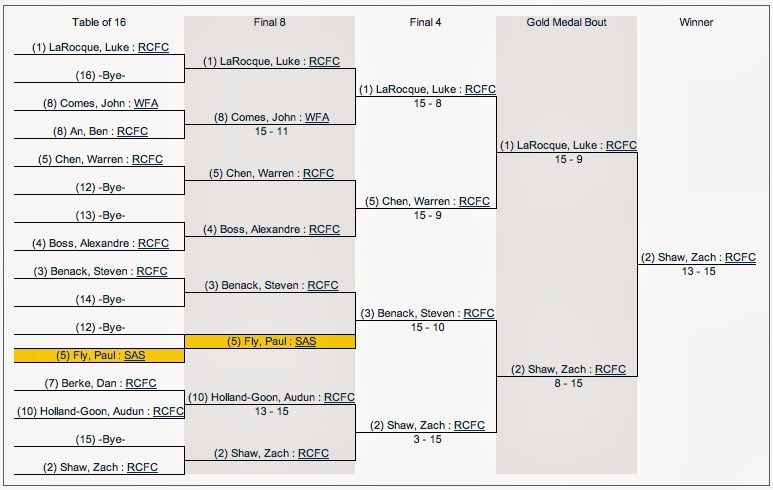
In the other pool the results were: Zach Shaw 1st, then Steven Benack, Alexandre Boss (another foilist?), John Comes, and Audun Holland-Goon. In the post-pool seeding I was 5th, along with Warren Chen. Lucky for us—since there were ten of us the 7th through 10th seeds had to fence in the table of 16, while the rest got a bye.


In those first two DEs John Comes fenced Ben An—they were tied for 8th seed. John won, 15-11. And Dan Berke fenced Audun Holland-Goon. I forget the exact details, but toward the end Dan was up several points and looking like he would win. Then Audun staged an impressive comeback and won 15-13.

In the table of 8 I faced Steven Benack. I had fenced him in a DE in the last D and under tournament we were in, at SAS. I had won, and I thought I had a pretty good idea about how to beat him again. Basically, he's a french-grip, "blade hiding" counterattacker who tends to retreat a lot, then fleche straight in when your attack falls short or you are otherwise open. So my basic tactic is to be very patient and use footwork, distance, and various feints to draw his fleche, then parry or bind it up. However, tonight my focus was poor and I was not patient enough. I felt slow, and as a result my attempts to draw his fleche kept failing because, I figured, I was being a little slow and obvious and he could tell I was feinting and trying to draw him out. Rather than counterattack he kept retreating. I think I began to get annoyed at myself for being slow and unconvincing, so I increased the pressure. But in general the effect of this wasn't to make my feints more believable so much as turn them into actual attacks, which he was usually able to avoid and counterattack into, just like he likes to do. Our score was fairly close for a while, but he pulled ahead, perhaps as I got more frustrated and desperate, and he ended up winning 15-10.

Afterward he said I was being impatient and kept initiating attacks, like he likes. Yep. Later Matthew Comes, who was there, asked me who took me out. When I said Steven he responded with some thoughts on how he deals with Steven—that basically Steven does one thing: he holds back and holds back and holds back, then fleches straight in, or perhaps with a sweeping circle-6 like motion. Matthew said that because Steven tends to only do that one thing he, Matthew, can usually hit him by fleching straight in. That may be, for Matthew, whose fleche is so much better than mine. But then I mentioned how I felt I knew how to beat Steven but was feeling tired and slow tonight. Matthew's response to that was interesting. He said when you feel slow you can slow down your fencing. Fencing slow then gives you more "space" to accelerate, and he talked a bit about how important acceleration is, which I know all about but had not been thinking of this evening. He also pointed out how pretty much all the fencers tonight were keeping more or less to the same tempos—they weren't using much acceleration—and more so, they were tending to match the tempo of their opponent. In such a situation if I was feeling slow I could have used that tactically, but slowing the tempo and making accelerated attacks more deadly. I thought that was spot on. A couple months ago I had been practicing acceleration a lot, but lately have not been thinking about it as much, instead focusing on absence of blade and distance stuff. I ought to try and combine the two more fully.

At one point John Comes, Matthew's dad, heard us talking and jokingly said "hey, you're giving advice to the enemy!" I know he was joking, but still, thanks Matthew. That kind of chatting makes me want to visit WFA someday. I have no idea if they welcome folks for open fencing, or even what their club is like. Something to look into perhaps.

The rest of the tournament went more or less as expected. After Audun's nice comeback against Dan Berke he lost to Zach Shaw 15-3. Luke beat John Comes 15-8. Warren Chen took the other spot in the final 4. In the semis Luke handily beat Warren, 15-9, and Zach beat Steven, 15-8. So the top two seeds fenced for first place. Luke was the top seed and had been fencing great all night, but he floundered against Zach. They are clubmates and probably fence a lot. They joked around a little. Luke took an early lead but Zach seemed to adjust and soon took a large lead. The first period wasn't even halfway over before the score was something like 13-8, Zach. Soon it was 14-9, I think. Looked almost over for Luke, yet he managed to score at least three single lights, with Zach at 14 the whole time. Finally the comeback ended with a double touch. So Zach won, 15-13.

Sunday, March 16, 2014

Open Mixed Epee at SAS, March 16, 2014

http://askfred.net/Results/results.php?tournament_id=24375&highlight_competitor_id=91067&event_id=97555

Well, I didn't do too well, 19th out of 20, but that was one of the more interesting, unusual, and exciting tournaments I've been to. It "should" have been an A1 but became a B1. Many of the Ds and Es fencing were probably better than their ratings, and some of the higher rated fencers were not fencing their best, so it was almost like all 20 of us were relatively well matched—or at least more well matched than the raw ratings might suggest, so things could have turned out any number of ways. Also, there were a number of 15-14 bouts, including the final, and a bunch of other close bouts. There were a few upsets, in both the pools and the DEs. The best rated fencers didn't do as well in the pools as they were "supposed to".

My pool was #3, the smaller one, unfortunately, and I ended up one and four, so meh.


I started with Jay Slater (my pool's A fencer, who went on to win the tournament), first bout of the entire pool, and I got a good start, bouncing in with energy. I think I was even up a point, 2-1 or so. But Jay, well...I lost 5-3. Still I considered it a decent start. Jay was using his french grip, which he's getting very good at, but I think I prefer his using french grip over pistol.

After a one bout break I fenced my other clubmate in my pool, Jim Arrigoni. It was an ugly bout, with lots of  reckless charging and desperate off balance jabbing. Almost by chance, it seemed, we ended up at 4-4, followed by another "ugly" exchange that I happened to score on. So I won, 5-4. Then I had several bouts to wait before going up against Jim Henderson. The last few times I've faced him I've lost and I still can't quite figure out what to do. I tried my recent thing with absence of blade and working on distance, trying to use good, active footwork, and tried to get him in the "dead" zone, as I think my reach is slightly longer than his. But he is quick on his feet and quite fast with the blade, and kept beating me to the punch when we got into exchanges. I lost 5-3. He seems to have a well-rounded game. If only I could find a weakness... Then I fenced Carlo Malaguzzi. I figured I had a chance with him, but I had to fight for it. Again I worked with absence of blade, distance, and watching for his fleches. I think I caught one of his fleches. I also kept my eye on possible thigh hits, as he seemed possible open to low line attacks. And I think I scored once or twice that way. We went to 4-4. It felt like it could have gone either way, but he got the final point, so I lost 5-4. My last bout was against Matthew Comes, who I have had great trouble with. Earlier in the pool I watched Carlo beat him 5-1, and talked to Carlo a little about it. So I went in planning to do what Carlo had done—which seemed to be drawing Matthew's fleche then parrying/sweeping very hard in 8 or 2. Matthew was using a french grip and Carlo's parries were strong enough to knock Matthew's epee right out of his hand more than once. Well, when I tried that I kept finding Matthew hitting me before I even knew it was coming. I was ready to try strong 8 or 2 type parries, and/or 7 or primes to mix it up. But as with other times I've fenced Matthew lately I could barely manage anything, and lost, 5-1. I try to keep my awareness hyper-focused for the slightly sign of his fleche or his toe-touches, yet they still catch me by surprise. Perhaps a new tactic next time. Sometime different from baiting him. Perhaps much more distance. Hell, I score so badly in pools with him perhaps I should try for low scores and running time out, trying for doubles when I must...

So I came in last place in my pool, though only by one point compared to Jim Arrigoni. We both won just one bout, and we both received 24 touches, but he scored 17 to my 16 touches. Ah well.

The other pools had interesting results. In pool #1 George Raush cleaned up, winning all bouts but one. He lost to Zach DeWitt, which seemed odd since Zach did rather poorly. Mark Blom and Luke LaRocque both went four and two, while Yuly Suvorov, the pool's A fencer, was only three and three, losing to George, Mark, and Luke. In pool #1 Andrew Lee cleaned up and took 1st place, winning all but one, losing only to Cameron Brown; and Cameron won all but two. John Varney, the A of the pool, also won all but two but ended up with an indicator one point less than Cameron's, so came in third in the pool. Meanwhile David Robert, the line U in the tournament (though he's overdue for an E or D rating), went three and three while Russ Redding, one of the two Bs, went two and four.

In short, the pool results did not jive very well with fencers' ratings. The top seeds were George Raush, a C, Andrew Lee (D), Carlo Malaguzzi (D), Matthew Comes (B), Mark Blom (D), and Cameron Brown (D). The three A fencers, John Varney, Jay Slater, and Yuly Suvorov, seeded 7th, 9th, and 10th. Rather mixed up! It was mixed up enough, in fact, that it looked likely that the tournament might end up a B1 instead of an A1, which is in fact what eventually happened.

I seeded 18th, which paired me with Russ Redding, my own coach!, who seeded 15th. People pointed out that if I won the tournament would be a B1. In order to be an A1 it needed at least two As and two Bs or higher in the final eight. We had three As and two Bs total, and two of the As were going to fence in the table of 16, so only two A could possibly make the final eight. Therefore both Bs had to also make the table of eight for the tournament to remain an A1. Russ was one of those Bs. And we fenced in the table of 32.

Of course I didn't let any of that stop me from fencing my best. I thought it was possible to beat Russ. I had been doing pretty well against him in practice lately—getting a fair number of arm hits and escaping his fleches with quicker footwork. And he was using a french grip, which gave me a little extra confidence. I mainly fenced absence of blade with quick footwork, although I knew it was very hard to trick Russ on distance. He tends to hold his blade out, trying to get you to beat or bind it. Sometimes I'm able to, but mainly he's able to disengage out, especially when he's fencing french grip. So I tried to mainly use beats and binds as feints, setting up second intention type stuff. Or feinting attacks but then holding back looking for an arm hit from below or a low line. We went back and forth, mostly tied or nearly so. At one point he got up three points, 5-8 I think, but I caught up and we tied off and on to 12-12. We started the 3rd period tied 12-12, but alas, he got the last 3 points and won, 15-12. The first point was my fault—I basically stuck my hand onto his point, argh. The second point I thought I had—we had closed to near-infighting and I had my point right on his stomach, while his blade was far out of line. I thought I had hit, but he had bent over enough to just escape my point while at the same time doing a rather desperate flick and hit and scored. Argh! The final point was relatively unremarkable. So close! On the other hand, I fenced with my relatively new tactic of being confident. I also summoned with some success the feeling of fencing Russ and doing well. I didn't win, but I think these mental things helped me fence better.

The rest of the DEs were quite exciting with many very close bouts. In the table of 16 George Raush and Jim Arrigoni fought to 14-14, with George getting the final point. Jay Slater and Luke LaRocque also went to 14-14. Luke was doing really well against Jay, trying to draw him out and counterattack, I think. Jay managed the last point and won 15-14. Mark Blom and David Robert also went to 14-14, with Mark getting the final point.

And perhaps most exciting, in the table of 16, was Andrew Lee and Russ Redding. They also went to 14-14, then time ran out. Russ won priority and they went into sudden death. Both started carefully. Andrew fleched, Russ blocked him out with his excellent prime parry, but neither scored. I think that happened a number of times during the full bout. Russ has such a good prime parry, and he used it to stop Andrew's fleches a bunch of times. But Russ was having trouble landing the riposte from prime, so usually he'd manage to block Andrew but neither would score. Afterward Russ was talking to someone about his prime parry and said the french grip makes the prime and its riposte a little harder. He's usually pretty good with the prime ripostes, at least with me (!), but perhaps better with his pistol grip, now that I think about it. Anyway, continuing sudden death, there was a double touch, thrown out. Spectators were making comments about it being a "nail biter" bout. Finally there was an exchange and Andrew went for the foot and hit. There was a moment of uncertainty—had he hit, was it the floor? They were on a grounded strip, but still. Marshall was reffing and paused for a second. Andrew looked uncertain for a moment, then Russ said "oh that was good". And Marshall, who perhaps wasn't pausing out of doubt, called bout. So Andrew won in sudden death, 15-14.


Andrew beating Russ turned the tournament into a B1. Well, the relatively poor performance of the three As in the pools had at least as much to do with the event turning into a B1, but we didn't definitely become a B1 until Andrew beat Russ. John Varney and Yuly Suvorov were the two As who fenced in the table of 16. Yuly won, 15-11. Marshall was the ref and before they began he jokingly scolding them: "You guys are not supposed to be fencing each other yet!"

There was a moment after Andrew Lee beat Russ that Robert Lampson, who was watching next to me, thought that Andrew had earned his C as a result, but no, he had to come in 4th or higher for that. There was another moment when I thought perhaps Andrew would have earned a C for beating Russ if the tournament was rated A1, but by beating Russ the tournament became a B1 and thus Andrew did not earn a C. That would be sucky, I thought—to win and earn a C, but by winning not earn a C! But looking into it I realized the difference between an A1 and a B1 is minimal. In fact, the only difference seems to be that in an A1 tournament the first place fencer earns an A and the second place a B, while in a B1 only the first place earns a B. Everything else is the same: C down to 4th place, D for 5-6 and E for 7-8. Perhaps this system is designed in part so that situations like what I imagined—earning a rating by beating someone better, but then not earning it because you beat someone better—don't happen or are highly unlikely.

The final 8 bouts were not as close—Jay beat George, 15-8. Matthew Comes beat Mark Blom, 15-10. Cameron Brown beat Carlo, 15-12, and Yuly beat Andrew Lee, 15-10. The semifinals were even less close: Jay beat Matthew Comes, 15-9, and Yuly beat Cameron Brown, 15-8:


 The final bout, however, was very close. Jay vs. Yuly. I had watched them practice just the day before, both working hard for quite a while, and looking pretty evenly matched. Yuly mostly held the lead in the final bout, but Jay caught up in the end, getting to 14-14 and winning the final touch, 15-14. I made a full video of this bout:


So, despite the rather wacky pools and DE seeding, two of the three As did manage to get to the final bout, and one of the two Bs tied for third. But the third A, Varney, came in 9th, below three Ds and two Cs. David Robert, the one U, came in 12th out of 20, above one B and two Cs. No one earned new ratings, although Cameron Brown renewed his C and Andrew Lee his D. Me, well, the only thing that stopped me from coming in absolute last was John Comes, who lost all his pool bouts. Apparently he hasn't been fencing very much recently, trying to recuperate from back troubles. Still, despite doing poorly I had a good time watching everyone else. It was nice to realize out of the 20 fencers I knew them all—mostly pretty well and friendly.

The next local epee tournament is a Thursday evening RCFC event, but so far only six people have signed up. About a week after that is the WWD Div II/III qualifier event. That should be interesting.

Tuesday, March 4, 2014

Open fencing at RCFC

Thanks to Jeff's prodding and my long interest in trying it, I finally got around to an evening of open epee at Rain City Fencing Center. It was great—getting to fence, in a non-tournament setting, people I've only fenced in tournaments, if at all. Jeff had given me the idea there might be quite a bit fewer fencers than at an SAS open fencing evening, but there was a good bunch. I was at least familiar with most of them, and most seemed eager to fence me—probably for the same reason I was eager: fresh blood! So I ended up working hard with just a few short breaks. It was all very enjoyable. I liked getting to know some of these people a bit better—tournaments are not as social as open fencing. I learned some things and did pretty well too, I think.

I thought I'd mention here who I fenced, because I'm sure I'll forget in time. Wulf Carson and I fenced first, and for quite a while. We hadn't fenced before but I had watched him come in second place in a vet tournament at RCFC a while back. After that I was a bit tired, but Hans Engel asked to fence and how could I turn that down? Then Luke LaRocque asked. I needed a couple minutes, but then we were up and fenced about 30 or so touches. We've fenced in tournaments a few times recently and have each won some and lost some. He said he wanted to figure out my...I forget exactly how he phrased it, but something like "fluid low line attacks". And I wanted to figure him out more. We had a fun bout, and pretty evenly matched, I think.

Then there was a bit of chatting with Jeff, Carlo, and Wulf—with me, the old guys. Although they kept saying I was the youngster—which...I guess, I'm about ten years younger, but still a lot older than most of the RCFC kids, like Hans and Luke (I only just realized how well their names go together). Then I fenced Carlo Malaguzzi. I think I'd only fenced him once before, in 2014 Leon Open DE, I think. He destroyed me then. I did somewhat better tonight. After that the place was starting to empty out, but Andrea Matessi was still there, so we fenced a while. We never had before, and had never properly met, although we both recognized each other from tournaments. He's quite good, so that was a nice learning bout. Finally Jeff Lucas and I fenced and the evening was over. Good fun. Will have to do it again sometime.

Sunday, March 2, 2014

D & Under Mixed Epee at SAS

http://askfred.net/Results/results.php?tournament_id=24378&highlight_competitor_id=91067&event_id=97560


Tied for third out of ten. With just ten fencers we decided to go with one big pool, which took most of the time of the tournament but was fun. There were four Ds (Charlie, Craig, Luke, and Steven), one E (me), and five Us (Jeff, Dell, Art, Isaac, and David). I was mainly worried about the Ds, although I knew I could in theory beat any of them. The question was whether I would. I wasn't as worried about the Us, except Isaac, who I didn't really know. I figured, even assumed I could and would beat them, but I was proved wrong twice.


I can't remember the exact order I fenced in, but it was something like:

Art Deal (U): I won 5-2. He got the two points fairly early, which worried me, but I adjusted and was able to basically use distance and absence of blade to coax him in.

Dell Wolfensparger (U): I lost 5-4, which surprised me a little. Perhaps I was foolish to go in assuming I would win. Dell was fencing with as much energy as he could muster, and I was being a little too relaxed. I also forgot that my absence of blade distance game doesn't seem to work quite as well with Dell. He managed to hit with several fleches, or fleche-like things. I think he got to 4-2. I concentrated on single lights and patience. I got one single light, 4-3, then my next attempt ended in a double, so he won 5-4. Way to go, Dell!

Jeff Wilkson (U): I think I mainly stuck with the absence of blade distance game and it worked well, 5-2. I said to him after it felt like my fencing brain finally turned on. It can take a couple bouts to get into the headspace.

Luke LaRocque (D): We've fenced a few times before and he's mostly beaten me. But the last time we fenced in a pool I beat him. If nothing else I have a decent idea about his style and able to go in with something of a plan. Still, I thought he would be tough. As it turned out I won 5-2. We both played an absence of blade game, more or less. He's taller than me so I had to be extra careful of distance. When he did fleche I was mostly able to parry, and sometimes score. I fleched him a couple times, at least one of which ended in misses, jabbing, and corp-a-corps. Another time I had pushed him down the strip a bit, we had some blade exchanges and a score beep sounded. Not sure I retreated and glanced at the box—no lights. The beep was from another strip. Luke took my glancing up as an opportunity and advanced quickly. I reatreated a bit more and prepared. He apparently still thought he had me off guard and fleched. I ducked and countered to his body. We crashed into each other rather spectacularly, but harmlessly. I can't recall now if neither scored or if it was a double touch. Either way it seemed kind of funny. Don was the ref and I guess the corp-a-corps looked worse than it was. He advised us (me really) to not look at the box. In hindsight it was almost to my advantage—I had retreated before glancing at the box, so I had plenty of time to prepare for Luke's attack. And apparently by glancing at the box I gave Luke the impression I was off guard and he ought to attack aggressively, but by the time he reached me I was more than ready. Perhaps this kind of thing could be a tactic against some fencers. Shortly after that I managed a nice lunge to Luke's forearm. That one felt good. Also, I seemed to have decent success with second intentions, feints and the like. Luke likes to attack and it didn't seem that hard to draw attacks, which then could be countered. His height and reach give him an advantage, but if he falls for feints and makes deep lunges or fleches he gets into trouble.

Isaac Dugaw (U): A fairly small kid from WFA. His stance is odd—he puts his weight on his front foot a lot, which can't be good. It seemed like I should have been able to beat him, but he won 5-3. In fact, looking at his pool results is interesting. He beat me, Charlie, and Steven, some of the toughest fencers today, but lost to Jeff, Dell, and David. Weird.

Charlie Muñoz (D): Charlie was fencing very well, as he has been recently. I did okay and it was fairly close. It got to 4-3 and Charlie went for and got a double, winning 5-4.

David Robert (U): I was able to do most of my usual tricks I've learned work with David, mostly beats and binds combined with fleches. I won 5-3.

Craig Haworth (D): I was ready for his constant circle sixes, and was able to make some doubles by circle-attacking the opposite way. But the fast, accurate flick he does at the end of a circle-six action I had trouble with. I tried coaxing him in with absence of blade, but his attack is a bit longer and faster than I expected. I needed to have kept a bit more distance. I did managed a nice thigh hit. In the end I lost 5-3.

Steven Benack (D): I was worried about Steven. He's fairly tall and fences extended French. He tends to use absence of blade (arm back) and counterattacks, with an occasional fleche if the distance is right. Having watched other people try to beat or take his blade despite being mostly out of reach I decided not to go that way and use absence of blade myself. Since he tends to hold his arm back in a kind of cocked, outside position, his counterattacks and fleches tend to come from an outside angulated direction. I had some success in drawing these attacks and either attacking into them or parrying into 8 or 6. Still, I misjudged distance and his speed and a couple times he nailed me with a direct fleche. He won, 5-4.

Craig was the top seed by quite a bit. He lost only one pool bout, and that 5-4, to Steven. Charlie was the second seed, having lost two, one to Craig and one to Isaac. Luke and Steven were 3rd and 4th seeds, very close. I was 5th.


So there were two DEs in the table of 16 (everyone else got byes). I was paired with Steven Benack in the Final 8. He had gotten a hard hit in the forearm during the pools and was off and on in pain, but seemed to still be fencing well. Twice during our DE he paused and held his arm, wincing in pain. I don't think I hit him in the forearm. Once it was after I bound up his blade rather strongly, which I guess his arm wasn't happy about. The other time I hit his upper arm, so I'm not sure what happened there. I felt bad for him though. Our bout was fairly even at first, mostly tied or within a point or two. In the second period I pulled ahead a couple points and managed to maintain the lead. I won 15-12. If I learned anything I suppose it might be—he likes to retreat and wait for a good time to counterattack. Often when someone does attack he'll simply pull his arm way back and retreat quickly out of range. A few times I kept the pressure on after that kind of thing, forcing him back and/or trying to draw his counterattack. Maybe, it seemed, he has some trouble when the pressure is on like that.

My second DE, in the Final 4 (small tournament!) was with Craig Haworth. The bout had some ugly moments where we both missed and jabbed. I mostly kept to my absence of blade patience game. But his rather relentless advancing kept pushing me back quickly. And I'm still not comfortable at my end of the strip, so I would stand my ground sooner than perhaps was wise. I knew his circle six was fast and strong enough to prevent me from simple hits straight in, even if I could get the distance a little in my favor. Instead I tried various second intention things, but too often he's launch a fast lunge and my arm would be bent and quickly hit. I did manage one lovely hit to his hand from below, which felt nice. On the other hand, I had been thinking a prime parry might work well against his circle-six-flick, but when I pulled out a real prime he was faster and stronger than the parry and powered through. Eventually he was up quite a bit. I think it was 12-8, which was looking pretty bad. Seeking a change of tactic I tried my 4-6 thing and it worked beautifully, making the score 12-9. So I tried it again and it worked very well again; 12-10, looking better. I figured he was probably getting wise to that so I tried to distract him with other things for a little bit before pulling it out again. I think I didn't execute it quite as well that time, and/or he was more ready for it, so we doubled; 13-10. If I remember right I tried the 4-6 thing again and we doubled again, 14-11, then we ended with a double, 15-12. I might be misremembering those final touches. Anyway, afterward he said my comeback near the end had him worried. It made me feel okay about the bout—to be down by four and find a tactic that makes a decent rally. But four points near the end is a lot. Russ said after that I should have been moving more. As usual he's probably right.

In the other Final 4 Luke beat Charlie. It was close until about halfway through when Luke realized he could score well with fleches, and that he ought to be holding his arm higher—he had been holding it pretty low, which Charlie was able to take advantage of.

So the final bout was Craig and Luke. Apparently they hadn't fenced in quite a while but had been "bad talking" each other in friendly rivalry about who would win when they did face each other again. So it was a fun final. Not just because these two finally got to test their trash talking, but also because everything was friendly and stress-free. Since it was an E1 tournament and both these guys had Ds there was no rating at stake. The whole thing was over within a single period. At first it was fairly even, but Luke pulled ahead and soon took a larger and larger lead. He won 15-10. I took video of most of it, below.

For coming in third, tied with Charlie, I got an Amazon gift certificate for $10. Luke got one for $25 for being first. The tournament itself cost $20 to fence in, so Luke made that up and then some. Part of me would prefer a medal, even if your average local tournament medal probably costs far less than $10. Craig joked he would use his gift certificate to *buy a gold medal*—more trash talk with Luke. Fun people though. I had a great time.


Sunday, February 23, 2014

MTFC 'E' and Under Mixed Epee

http://askfred.net/Results/results.php?tournament_id=24027&highlight_competitor_id=91067&event_id=96392

Well I did great in the pools, coming out 1st seed. But then I managed to lose my first DE to Eli Gandour-Rood, 15-13, whoops.

Doh!

I lost my first pool bout to Tom Martin. At first I was up a couple points. He got a few and we were at 4-3. Maybe I got overconfident; he scored, making it 4-4, then scored a single light again to win. I did very well in the rest of my pool bouts, winning two 5-0, one 5-1, one 5-2, and one 5-3. I was mostly worried about Jay Stainbrook and Sean Holland. Jay was doing very well too, but I had a fair amount of time to watch him before we fenced and I was able to devise a strategy that worked well (I won 5-2).


So I was the top seed and got a bye. Eli fenced Roger Brees and won 15-11, so I was matched with Eli. He used to go to SAS fairly often and we had fenced quite a bit. I couldn't quite remember what it was like but I think I usually did well against him. Maybe I was a little overconfident.

He scored the first two points as I probed and he did parry-ripostes. Then I shifted to a distance game tactic, using quick bouncy footwork to find those moments of closer distance, then attack straight in. That worked for several points. Then he adjusted to that and began using strong quick parries against my straight in attacks. So I began disengaging his parries, which worked but resulted in a string of double touches. I think I was up a couple points at the end of the first period. I went into the second period planning to shift between several tactics, such as setting up fleches, going for the thigh, and trying active disruptive blade work. These mostly didn't work so well, or I screwed them up. It wasn't a good fleching day for me. My disruptive bladework allowed him to score on my hand. I think I did manage a hit to his thigh though. Even so at one point I was up a couple of points, so I decided to ease off and play a patience game. Maybe I eased off too much because he got a couple points before I gave up that tactic. I think we reached 13-13. I tried my 4-6 trick but it failed, so he got to 14-13. I don't even remember the final point but it was his.

Well in any case whichever of us won had to face Charlie, which I hadn't been looking forward to—not just because he's my clubmate but because if we fenced one of us would have to lose and I didn't want either of us to lose. So I didn't have to fence him after all. Charlie took out Eli handily, 15-9, putting him in the final four. He fenced Alexander Nelson, a tall, counterattacking French-grip kind of guy. At first Charlie had some trouble. After the first period I was able to give some advice and he had some insights of his own. In the second period Charlie took to fleching a lot. It was working pretty well but even so they got to 14-14. Charlie made the final touch. That was a close one.

On the other side of the tableau Zach beat Donald Lake then fought a tough battle against Jay, the 2nd seed. Zach was down a bit but caught up, then they traded points for a while. In the end Zach won 15-13, putting him in the final four (and earning him his E). His semifinal bout was against Henry Duchow, who won 15-8. So the final bout was Henry and Charlie. Henry, like Alexander Nelson, is a tall, French-grip counterattacker. Charlie had just won against Alexander after figuring out a fleching tactic. In the final bout Charlie mostly fleched straight off the line, scoring over and over very quickly. It was almost saber-like, the speed of the attacks off the line. Henry apparently couldn't figure out a good defense and Charlie just kept doing the same basic thing, winning 15-11 and earning his long-sought D.

Afterward Jeff Lucas and I went for a late lunch and talked about octopusses.